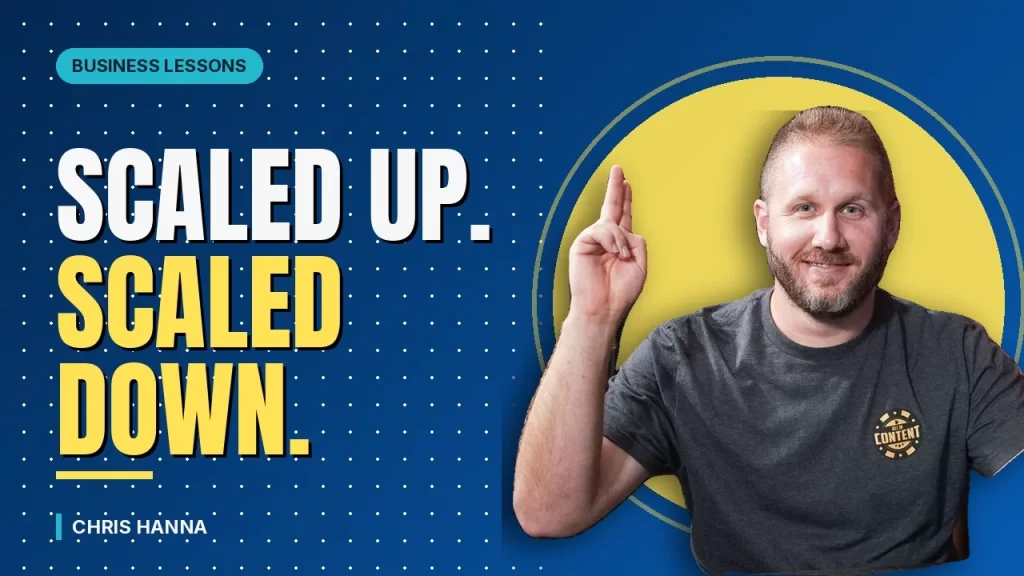
In the same year, I scaled my team up and then scaled it back down. I added services, then cut them. If that sounds messy, it was. Scaling a small business is one of those things everyone talks about like it’s a straight line up and to the right. Mine looked more like a heart monitor.
I’m sharing this because I think a lot of business owners are about to make the same mistakes I made, and almost nobody talks honestly about what it’s like to grow too fast and then pull back. Here’s what happened and what I learned.
Why I Started Scaling My Small Business
Business was moving. I had bigger clients, bigger ideas, and a new studio. It felt like the right time to grow, so I did what you’re supposed to do. I added people. I added services. I said yes to bigger projects with broader scopes.
Some of my clients were on larger monthly packages that bundled video, podcasts, strategy, one-on-ones, graphics, and event support. On paper, it looked like a company becoming a full-service agency. And for a while, it felt like that was where I was heading.
It also felt good. Bigger team, bigger packages, bigger conversations. Growth is addictive, and every new hire or new service gives you a little hit of feeling like you’re winning. That’s the dangerous part. When growth feels like success, you stop asking whether it’s the right kind of growth. I didn’t ask that question nearly enough.
What Went Wrong When I Scaled Too Fast
I Built a Business I Didn’t Actually Want
Here’s the honest truth. I never wanted to run a full-service agency. I wanted to make great video and help businesses show up consistently. But every yes pulled me further toward being the agency that does everything for everyone, and I wasn’t set up to deliver all of it profitably.
More Services Meant More Complexity
Every new service came with new processes, new tools, new skills, and new ways for things to go wrong. The business got harder to run, not easier.
The Clients Who Got the Most Took It In-House
This one surprised me. Several of the clients on the biggest packages eventually took the work in-house. I’d helped them build a system, and once it was running, they decided to keep it themselves. Good for them, honestly. But it meant the revenue I’d scaled up for wasn’t as stable as I thought.
Payroll Doesn’t Care About Your Plans
Adding people adds fixed costs. When revenue doesn’t keep pace, those costs get heavy fast. Every month felt like I was working to pay for the growth instead of the growth paying for itself.
Scaling a Small Business Back Down
So I made the hard call. I pulled back. I trimmed services, simplified what we offer, and brought the team back to a size that matched the work.
Scaling down felt like failure at first. It’s not the story you want to tell at networking events. But it made the business healthier almost immediately. Clearer offers, lower costs, and a lot less stress.
It also made me a better leader for the people who stayed. When you’re stretched thin, everyone feels it. Deadlines slip, quality wobbles, and nobody has the headspace to do their best work. A smaller, focused team with a clear job is a much better place to work than a bigger team trying to do everything at once.
Today, All In Content focuses on what we do best: batch video creation, done-for-you social media management, and podcast production. We stopped doing websites. We stopped trying to be everything. The business is smaller than it was at its peak, and it’s in better shape.
Lessons on Scaling a Small Business
Decide What You Want to Be Before You Grow
Growth amplifies whatever business you already are. If you’re not clear on what that is, growth will turn you into something you didn’t choose. Write down the business you actually want to run, and say no to growth that pulls you away from it.
Grow Revenue Before You Grow Costs
Hire after the work is there and steady, not because you expect it to be. Fixed costs are easy to add and painful to remove.
Be Careful With Do-Everything Packages
Big bundled packages look great until you have to deliver every piece of them. Make sure each service is profitable on its own, not just as part of a bundle. If one piece loses money every month, the bundle is hiding a problem.
Watch Which Clients Might Outgrow You
If you’re building systems for clients, some will eventually run those systems themselves. Plan for that. Don’t build your whole business around clients who could take the work in-house.
Scaling Down Isn’t Failure
Sometimes the smartest move is to get smaller. A business that’s the right size for its work is stronger than one stretched past what it can deliver.
How to Know If You’re Scaling a Small Business Too Fast
- You’re hiring based on hope, not steady demand.
- You keep adding services because clients ask, not because they fit your strategy.
- You’re busier than ever but not more profitable.
- You feel like you’re running someone else’s business.
- Every slow month feels like a crisis.
If several of those sound familiar, it’s worth pausing before your next hire or new service.
One more test I use now: if this new hire or new service disappeared in six months, would the business be worse off, or just smaller? If the honest answer is "just smaller," it probably wasn’t the right kind of growth. Good growth makes the business stronger, not just bigger. It should make the work easier to deliver, improve what clients get, or make the company more resilient. If it only adds headcount and complexity, slow down and think again before you commit.
What Scaling a Small Business Looks Like Now
These days I think about growth differently. I’d rather add clients to a clear offer than add new offers to keep clients. I want work that fits the business I chose to build. And I keep the team lean enough that one tough month doesn’t put everyone at risk.
It’s less flashy. It’s also a lot more sustainable. And honestly, I sleep better. That counts for more than any headcount number ever will.
FAQ: Scaling a Small Business
When is the right time to scale a small business?
When demand is steady, your current offer is profitable, and you know exactly what you’re growing toward. Not just when things feel busy.
Is it bad to scale a business back down?
No. Right-sizing a business is often the smartest move an owner can make.
Should I add more services to grow?
Only if they fit your strategy and you can deliver them profitably. More services often means more complexity, not more profit.
Want the Real Version of Growth on Your Stage?
Growth, mistakes, and right-sizing are some of my favourite topics to share with business audiences. See my speaking topics or invite me on your podcast. And if you want to see what All In Content focuses on now, take a look here.