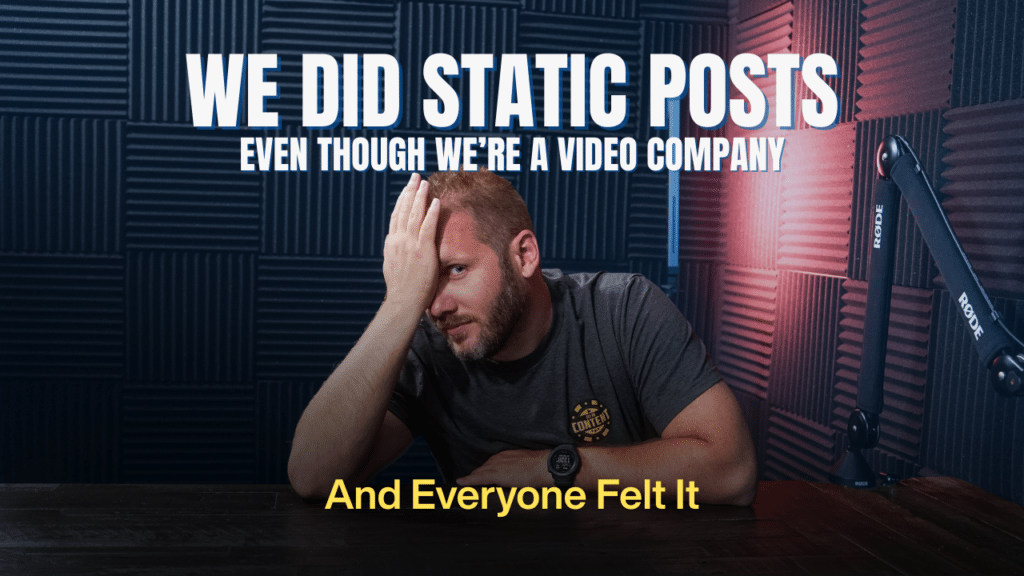
This one’s embarrassing to admit.
Not because it ruined the business. But because I knew better while I was doing it.
We’re a video company.
That’s our thing. That’s what we believe in.
And for a stretch, we still did static social posts.
Not because they worked. Not because we loved them. But because clients asked.
And everyone felt the misalignment — even if no one said it out loud at first.
This is how misalignment actually starts
It never starts with a big compromise.
It starts with something small.
“Can you also handle some static posts?”
“It’s just a few.”
“It’ll help round things out.”
It sounds reasonable. It sounds harmless. It sounds like good service.
It’s not.
It’s the beginning of dilution.
I hated the work, and that mattered more than I wanted to admit
Here’s the part I avoided for too long.
I hated doing static posts.
Not because they’re evil. But because they’re not what I believe in. They’re not where we create leverage. They’re not what we’re best at.
And when you hate the work, it leaks.
It leaks into:
- how you talk about it
- How much care you put into it,
- how confidently you stand behind it
You can’t fake conviction for long.
Clients don’t need to say it — they feel it
What surprised me most wasn’t my own frustration.
It was the clients’.
They didn’t always complain. They didn’t always articulate the issue.
But engagement was flat. Excitement was low. Conversations felt off.
They were paying for something that felt transactional — not transformational.
And deep down, they knew it wasn’t our core.
This is where most businesses screw up positioning
Here’s the mistake I see everywhere.
Businesses think positioning is what they say on their website.
It’s not.
Positioning is what you:
- defend
- refuse
- repeat
The moment you start offering things you don’t fully stand behind, your positioning weakens — even if the service is “fine.”
Fine doesn’t build trust. Conviction does.
Doing work you don’t believe in creates resentment
This part is subtle, but dangerous.
When you keep delivering work you don’t respect, resentment builds.
Not explosive resentment. Quiet resentment.
You start thinking:
“This isn’t why we built this.”
“This isn’t where our edge is.”
“This isn’t the work I want to be known for.”
And resentment poisons relationships — even professional ones.
I confused being helpful with being a leader
I told myself I was being accommodating.
What I was really doing was avoiding leadership.
Leadership would’ve been saying:
“This isn’t what we do best.”
“This isn’t where you’ll get the most value.”
“This isn’t aligned with how we work.”
Instead, I said yes. And then felt the consequences.
Static posts weren’t the problem — cowardice was
Let’s be clear.
Static posts aren’t the villain.
Plenty of companies do them well.
The problem was my agreeing to deliver something I didn’t believe in, to keep things smooth.
That’s not a strategy. That’s fear wearing a customer-service mask.
The moment I stopped, everything got cleaner
When we finally cut static posts:
- conversations improved
- expectations reset
- delivery tightened
- confidence returned
Some clients left. Others leaned in harder. Both outcomes were correct. The business immediately felt more honest.
Clients don’t want “more” — they want clarity
Here’s what I learned the hard way.
Clients don’t actually want you to do everything.
They want you to:
- know what you’re best at
- stand behind it
- guide them confidently
When you blur your own edge, clients don’t feel supported. They feel uncertain.
This applies far beyond content
This lesson isn’t about static posts.
It’s about:
- saying yes to the wrong work
- diluting your identity
- prioritizing comfort over clarity
Every time you accept work you don’t respect, you teach the market who you’re willing to be.
And once that story is out there, it’s hard to undo.
The line I won’t cross anymore
I don’t offer services I wouldn’t proudly sell again tomorrow.
If I don’t believe in it, it doesn’t belong in the business.
Period.
That line protects:
- focus
- energy
- reputation
And most importantly, self-respect.
Final thought
Doing static posts didn’t break the business.
But it showed me something important.
The fastest way to weaken your authority is to stop quietly standing for anything.
Conviction isn’t loud. But its absence is obvious. And once I stopped compromising on what we actually do, everything else fell back into place.